
N Chandrasekaran's exit marks a major shift for TCS, leaving its leadership to navigate AI disruption without the group chairman's deep expertise.

State Bank of India Chairman C S Setty stated that banks will take three to four months to deploy the significant funds mobilised through foreign currency non-resident (bank), or FCNR(B), deposits, which is unlikely to cause "abnormal lending". He also highlighted the need for agentic artificial intelligence (AI) costs to fall sharply for its widespread deployment in India, envisioning its role in transforming banking from fraud detection to personalised financial assistance.

A World Bank report highlights how Artificial Intelligence-powered weather forecasts have enabled small farmers in Telangana, India, to save up to USD 560 by adapting their farming practices to specific risks. The report, "The Promise of Artificial Intelligence," advocates for developing countries to rapidly adopt small, low-cost AI tools to enhance productivity, improve government services, and avoid missing out on the AI revolution.

Analysts predict that crude oil prices and the ongoing US-Iran conflict will be the primary drivers of stock market movements, with investors also closely watching the Jackson Hole symposium for cues on interest rates.

A rocket designed and developed by ISRO is being transferred to industry for production.
Nine ISRO associations want to know whether this is simply an effort to expand India's industrial capacity or part of a larger policy under which ISRO itself will eventually withdraw from rocket manufacturing.

US states, including Delaware, New York, and New Jersey, are issuing proclamations to commemorate August 15 as 'India Day', recognising India's independence and the significant contributions of the Indian American diaspora to the American fabric.

Indian companies' overseas expansion plans are holding strong despite geopolitical tensions in West Asia, driven by structural factors like supply-chain diversification, free trade agreements, and market expansion, according to Ajay Sharma, managing director and head of banking at HSBC India.
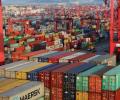
India's trade deficit reached a six-month high of $31.98 billion in July, driven by a sharp increase in imports, particularly crude oil, electronic goods, coal, and fertilisers. Both merchandise exports and imports recorded their second-highest levels during the same period.

Fitch Ratings has affirmed India's sovereign credit rating at 'BBB-' with a stable outlook, acknowledging robust growth prospects and strong external finances. However, the agency highlighted concerns over elevated government debt, lagging structural metrics, and potential fiscal spending pressures due to rising youth unemployment.
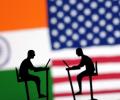
A Parliamentary Standing Committee on Commerce has urged the Indian government to swiftly conclude the proposed India-US Bilateral Trade Agreement (BTA), while ensuring India's interests are protected, recommending complete exemption for key export products like generic medicines and smartphones from future US tariff increases.

'They are claiming that they are very good in governance. All governments do propaganda. This is the propaganda of the government that they are doing very well, in spite of all the troubles.'
'They are claiming that they are very good in governance. All governments do propaganda. This is the propaganda of the government that they are doing very well, in spite of all the troubles.'

Justice Ashwani Kumar Mishra was sworn in as the Chief Justice of the Punjab and Haryana High Court, despite strong objections from the Punjab government. The Mann government claimed the appointment bypassed constitutional norms and procedures, leading to a political tussle with the Centre, which defended the process.

Indian stock market benchmark indices Sensex and Nifty closed nearly one per cent higher, extending their winning streak for a second day. This rally was driven by softening crude oil prices, positive geopolitical developments, and significant buying in blue-chip IT stocks, despite a broader global tech sell-off.

'The fundamental issue that I have raised, how come India's GDP in current prices went down from Rs 86 lakh crore down to Rs 80 lakh crore -- a staggering erasure of Rs 6 lakh crore. This disappearance of Rs 6 lakh crore has not been answered by anyone.'

The challenge thrown by the youth movement creates the opportunity for a more consequential debate on India's economic trajectory because it must remain centered on India's youth as its driving impulse, asserts former foreign secretary Shyam Saran.

India's gross Goods and Services Tax (GST) collections surged by 15.4 per cent to over Rs 2.11 lakh crore in July, driven by increased mop-up from both domestic transactions and imports.

A collection of 688 autographed reflections by Mahatma Gandhi, compiled into 'A Thought for the Day', was sold for a record Rs 16.20 crore at a Saffronart auction, becoming the world's most expensive Indian historical document sold at auction.

Gandhi's 1931 passport for his travel to London was issued in Bombay. It was the last time the Mahatma travelled abroad.

The Reserve Bank of India (RBI) has maintained its benchmark policy rate at 5.25 per cent for the fourth consecutive meeting, prioritising clarity on inflation trends, particularly concerning energy costs and geopolitical developments.
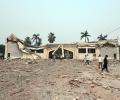
Former Chief of Defence Staff Gen Anil Chauhan (retd) revealed that Prime Minister Narendra Modi directed an 'unthinkable' and 'big lesson' action against Pakistan following the April 2024 Pahalgam terror attack, emphasising India's zero-tolerance policy for cross-border terrorism and the need for irrefutable evidence.

Union Finance Minister Nirmala Sitharaman announced the government's plan to establish a high-powered committee to examine reforms for the banking sector, aligning it with the vision of a 'Viksit Bharat' (Developed India) and India's next phase of growth.

'Every period of excessive optimism eventually gives way to a correction, while periods of extreme pessimism often create the best investment opportunities.'
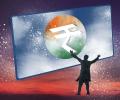
The Indian government has approved the introduction of one billion polymer banknotes in Rs 10 and Rs 20 denominations for field trials, aiming to enhance durability. This move comes as the Finance Minister also addressed Parliament on declining retail inflation, GST reforms, and other fiscal measures taken to support the economy and household consumption.

India launched 'Suryapath Tiranga', a unique initiative involving over 50 Indian missions globally, to digitally relay images of the tricolour across multiple time zones, starting from Fiji, to mark the country's 80th Independence Day.

Underlining that students are the "architects of India's future," President Droupadi Murmu on Friday said the government is taking comprehensive steps to reform public examinations to completely curb paper leaks and unfair means, making the system transparent, secure, and trustworthy.

The Reserve Bank of India (RBI) maintained its key policy rates for the fourth consecutive time, keeping the repo rate at 5.25 per cent, while the benchmark BSE Sensex closed 152 points higher in a volatile session, recovering from an intraday dip.
ServiceNow Vice Chairman Nick Tzitzon highlights India's potential to develop an AI-native government model, emphasising enhanced public services, data privacy, and economic growth.

Tewolde Gebremariam, a seasoned aviation professional with extensive experience at Ethiopian Airlines, has been named the new Chief Executive Officer and Managing Director of Air India. He is tasked with leading the airline's ambitious five-year transformation plan, Vihaan.AI, aimed at achieving significant growth and profitability, marking him as the second foreign national to helm Air India under Tata Group ownership.

'Applying AI to change the lives of Indians and at population scale -- just like we did with DPI [digital public infrastructure] -- is really where it's going to go.'

In her address to the nation on the eve of the country's 80th Independence Day, the president stressed that just as government and society remain united to ensure national security, everyone must contribute through joint and concerted efforts to safeguard the present and future of students.

'It could be in IT, it could be in administration, it could be in legal, it could be in technical services, but entry level jobs are rapidly disappearing because AI is taking them over.' 'So, the big question what would happen if the bottom rung of the ladder is removed?'

'The ethanol blended with petrol programme should not be halted or reconsidered.' 'India is not experiencing a structural sugar shortage, and the ethanol blending roadmap does not compete with food security or drive domestic price increases.'
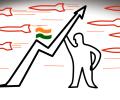
'A favourable base, last year's policy measures, the carryover impact of a good monsoon and improving earnings should all help.'

'It is not because of the war in West Asia, which began on February 28.' 'Petroleum product prices are already going through the roof. They are bound to have a serious inflationary impact.' 'A country's leadership is tested in trying times. It is here that the current leadership is failing.'

Moody's Ratings has highlighted that Indian banks are among the most exposed in the Asia-Pacific region to the West Asia crisis, primarily due to India's high dependence on energy imports, which could lead to increased inflation, higher interest rates, and strained borrower cash flows.

Hangors are effectively 'dead-on-arrival' with Pakistanis saddled with deadweights that displace around 3,000 tons. Last time it was near Vishakhapatnam. This time, barnacles will clog the Hangors in Karachi port itself, points out Dr Abhishek Puri.

Indian cricket captain Shubman Gill shared his approach to handling pressure, focusing on controllable factors and avoiding external influences.

'It will take a long time to recover from the impact of this war.'

'Healthy double-digit returns are still possible, though a sharp rally is unlikely.'
